The Science / Botulinum toxin
How Botox works, and how it stops working
It relaxes one muscle at a time, and quietly works on the skin itself. Done well, it softens the lines your expressions carve. Done carelessly, it flattens a face, or slowly stops working altogether. The distance between them is dose and placement.
"Botox" is a brand name. The drug is botulinum toxin type A, and its core action is exactly one thing: it stops a muscle you choose from contracting. Almost everything useful about it, and everything that can go wrong, follows from that single fact.
What Botox does
Skin creases in two ways. Dynamic lines appear when you move: the vertical furrow between the brows when you frown, the horizontal bands across the forehead when you raise them, the fan of crow's feet at the outer eye when you smile. Static lines are etched into skin at rest, from years of the same movement plus sun and lost collagen. Botox works on the first kind. By quieting the muscle underneath, it lets the skin above it lie flat. Those three areas, frown lines, forehead lines, and crow's feet, are the cosmetic uses cleared by the FDA.
The effect is neither instant nor permanent. It begins in a few days, reaches full effect around two weeks, and fades over roughly three to four months as the nerve recovers. What it can do over years is preventive: relax a muscle often enough and the dynamic line has less chance to deepen into a permanent one.
The same off-switch has many other uses. Placed in the masseter it eases jaw clenching and can slim a square jawline; in the neck bands, the upper lip, or around a "gummy" smile it adjusts how the lower face moves; injected into the underarms it switches off the sweat glands, an approved medical use in its own right. Beyond aesthetics the same drug treats chronic migraine, an overactive bladder, and muscle disorders such as cervical dystonia. It is a precise tool, not a beauty trick.
How it works
A muscle contracts when the nerve feeding it releases a messenger called acetylcholine across the tiny gap to the muscle. To release it, the nerve uses a set of docking proteins called the SNARE complex, one of which is SNAP-25. Botulinum toxin type A is taken into the nerve ending, and its active "light chain" cuts SNAP-25. With that protein cut, the SNARE complex cannot form, the vesicle of acetylcholine cannot fuse and release, and the signal never crosses. The muscle, receiving no instruction, stays relaxed.
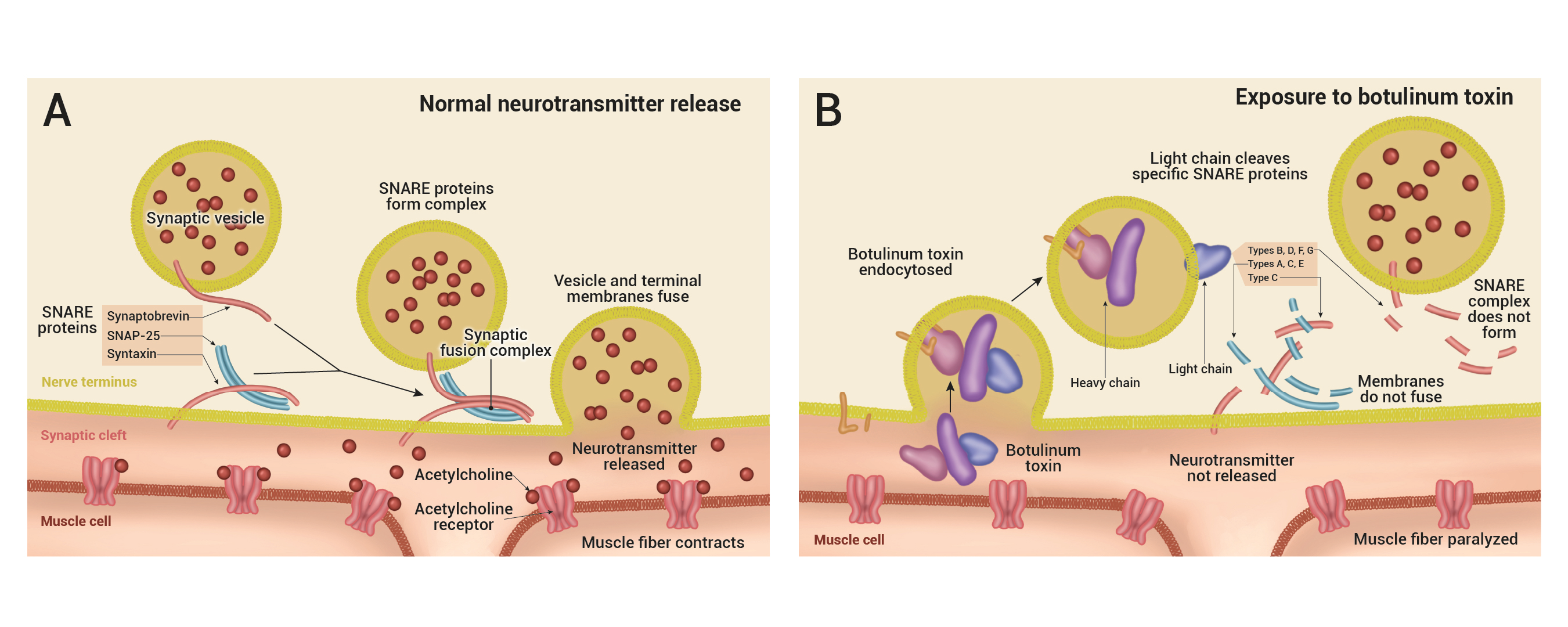
Two properties of this matter. It is local: the toxin acts where it is placed and, at cosmetic doses, does not meaningfully travel. That is the source of both its safety and its demand for precision, because a millimetre into the wrong muscle produces the wrong result. And it is reversible: the nerve slowly grows new endings and replaces the protein that was cut, which is why the effect wears off in months and why the treatment is repeated rather than permanent.
Does it do anything for skin quality?
There is a newer part of the story, still being studied. Beyond relaxing muscle, repeated injections and very shallow intradermal "microtox" have been reported to improve the skin itself: better elasticity and pliability, and lower roughness, higher hydration, and less water loss through the skin. These findings come from small studies, so they are early rather than settled.
The likely mechanisms sit in the skin, not the muscle. The toxin appears to affect collagen: some studies show more procollagen and better-organized collagen fibers after injection, though not all find a change in collagen or elastin levels. It also binds a growth-factor receptor, FGFR3, which is present in skin; in cultured skin cells it raised collagen production and lowered the enzymes that break collagen down. Injected shallowly, it also reduces oil and pore size, probably by dampening acetylcholine near the oil glands. The through-line is that the drug reaches past motor nerves into sensory nerves and skin, and that part is still being worked out.
How it's dosed
Botulinum toxin is dosed in units. As a rough guide, softening the frown lines takes on the order of twenty units of Botox across a handful of points, crow's feet a little more, the forehead usually less. Those are only starting points. The right dose depends on how strong your muscles are and how your face moves, and it often differs between the two sides of the same face.
Is it safe, and who should avoid it?
At cosmetic doses the margin of safety is wide, and the common side effects are temporary and depend on technique: a small bruise, a brief headache, and the two most people fear, a drooping eyelid or a heavy, uneven brow. Both come from the drug reaching a muscle it was not meant to, and both fade as it wears off. The serious systemic warnings you may read about, trouble swallowing or breathing, come from the far larger doses used to treat medical conditions and are essentially not seen in aesthetic use.
It is not right for everyone. Talk to a clinician first, or hold off, if any of these apply:
- You are pregnant or breastfeeding.
- You have a nerve or muscle condition such as myasthenia gravis, Lambert-Eaton syndrome, or ALS.
- There is an active skin infection where you would be injected.
- You have had an allergic reaction to a botulinum toxin product before.
- You take medications that can amplify the effect, such as some antibiotics or muscle relaxants. Tell your injector.
The bigger risk is not the drug itself but where it comes from. A genuine vial, stored correctly and drawn up by someone trained to measure it, is what makes the dose mean anything. The FDA and the CDC have both documented harm from counterfeit and mishandled "Botox" injected outside licensed care.
How the brands differ
The familiar names are all the same active molecule, botulinum neurotoxin type A. What differs between them is everything around that molecule. Four things, specifically:
- Accessory proteins. In nature the neurotoxin travels wrapped in non-toxic "complexing" proteins. Botox and Jeuveau keep them, Dysport carries less, Xeomin strips them entirely (the "naked" toxin), and Daxxify replaces them with a stabilizing peptide. These proteins fall away within minutes of injection, so their main real-world relevance is not how the drug spreads but how the immune system sees it.
- Unit scale. Each product's "unit" comes from its own potency assay, so units are never interchangeable. Dysport runs roughly two and a half to three of its units per unit of Botox; Botox, Xeomin, and Jeuveau are roughly one to one with each other; Daxxify has its own scale.
- Formulation and storage. Different stabilizers and different handling. Xeomin and Daxxify are stable at room temperature before mixing; Botox is kept refrigerated.
- Onset, spread, and duration. The differences patients actually feel, and the evidence is modest. Dysport tends to start a touch faster and spread a little wider, which suits a broad forehead and asks for care near precise muscles. Daxxify's distinction is a longer duration, often around six months rather than three to four. Much of the perceived difference in spread is really dilution and technique, not the molecule.
- Botox onabotulinumtoxinA
- The original and the most studied. The reference the others are measured against, with the longest track record across faces.
- Dysport abobotulinumtoxinA
- A different unit scale and a slightly faster, wider action. Well suited to broad areas, and a reason for a careful hand near delicate ones.
- Xeomin incobotulinumtoxinA
- The stripped-down, "naked" toxin with the accessory proteins removed. The purity is the argument for it in people who are treated often.
- Jeuveau prabotulinumtoxinA
- A cosmetic-only product, roughly one to one with Botox, made purely for aesthetic use.
- Daxxify daxibotulinumtoxinA
- A peptide-stabilized formulation notable for lasting longer in trials, often around six months.
How Botox can stop working
Here is the part almost no one mentions at the counter. Botulinum toxin is a foreign protein, and the body can learn to neutralize it. With repeated exposure some people form antibodies against the toxin, and once that happens the injections quietly stop working. Clinicians call it secondary non-response: the same dose, in the same muscle, does nothing.
Two facts make this matter more than it sounds. First, it is driven by dose and frequency. Large amounts, short intervals, and "top-up" touch-ups between sessions are what raise the odds; small doses spaced properly rarely do. Second, and the part that surprises people: because every type A product shares the same core toxin, resistance usually applies to the whole class. If your body has learned to neutralize Botox, switching to Dysport or Xeomin will not rescue you, and those antibodies can persist for a long time, often a year or more.
This is where the wrapper comes back. The accessory proteins that differ between brands add to what the immune system sees, which is the real argument for a purer formulation in someone dosed frequently. But the larger lever is not the brand at all. It is the dose and the interval: the smallest amount that works, no more often than needed.
Used sparingly, it can keep working for decades. Chased with bigger, more frequent doses, it can stop working in years.
So the amount and the timing are not only about today's result. They decide whether the treatment still works years from now, which is the real reason to set the dose to the person and repeat it no more often than needed.
Common questions
Does it hurt?
Not much. The needle is very fine and each injection takes a second or two, more a quick pinch than pain. Numbing cream or ice helps if you are sensitive.
When will I see results?
Within a few days, with the full effect around two weeks. Judge it at two weeks, not the next morning.
Will I look frozen?
Only if it is overdosed or misplaced. Dosed to your muscle strength, it softens lines while leaving your expression intact. A frozen look is a dosing and placement error, not something the drug does on its own.
How long does it last?
Usually three to four months. Daxxify tends to last longer, often around six. It can fade faster in strong muscles and stretch longer with consistent treatment over time.
Can I become resistant to it?
Rarely, but yes. Large or frequent doses can prompt your body to form antibodies that neutralize the toxin, and because the brands share the same core molecule, that resistance usually applies to all of them. Conservative dosing and proper spacing are the protection.
Is one brand better than another?
For most faces the differences are small. Dose, placement, and the injector's skill matter more than the brand. The right product is chosen to the area and to you, not by name recognition.
- Brin MF, Burstein R. Botox (onabotulinumtoxinA) mechanism of action. Medicine (Baltimore), 2023.National Library of Medicine, PMC
- BOTOX Cosmetic (onabotulinumtoxinA), Prescribing Information.U.S. Food & Drug Administration
- Jeuveau (prabotulinumtoxinA), Prescribing Information.U.S. Food & Drug Administration
- Daxxify (daxibotulinumtoxinA), Prescribing Information.U.S. Food & Drug Administration
- Conversion ratio between Botox, Dysport, and Xeomin in clinical practice.National Library of Medicine, PMC
- AbobotulinumtoxinA vs onabotulinumtoxinA for facial rhytids: a triple-blind comparative study.National Library of Medicine, PMC
- IncobotulinumtoxinA (Xeomin): a botulinum neurotoxin type A free from complexing proteins.National Library of Medicine, PMC
- DaxibotulinumtoxinA for glabellar lines: Phase 3 SAKURA 1 and 2 results.National Library of Medicine, PMC
- Bellows S, Jankovic J. Immunogenicity associated with botulinum toxin treatment. Toxins, 2019.National Library of Medicine, PubMed
- Complexing protein-free botulinum neurotoxin A formulations: implications of excipients for immunogenicity.National Library of Medicine, PMC
- Immunogenicity of botulinum toxin type A in clinical and cosmetic treatment: a literature review. Life, 2024.National Library of Medicine, PMC
- Counterfeit version of Botox found in multiple states.U.S. Food & Drug Administration
- Harmful reactions linked to counterfeit or mishandled Botox.Centers for Disease Control & Prevention
No commitment. We will email you about events and our opening date.